Chiefs' Tyquan Thornton Out Indefinitely; NFL May Fine Raiders' Stukes for Tackle
The short version
- Chiefs WR Tyquan Thornton dislocated his ankle on a 55-yard catch against the Raiders on October 4, 2026.
- NFL Network's Ian Rapoport: the ankle was reset, Thornton flew home with the team, and he is out indefinitely pending further evaluation and a second opinion.
- Raiders S Treydan Stukes was not flagged, but the NFL can review the tackle and fine him if it is ruled a hip drop.
- Hip-drop fines: $17,911 for a first offense, $23,882 for a second.
- The NFL banned hip-drop tackles in March 2024, citing a 20 times higher rate of lower-body injuries.
Kansas City wide receiver Tyquan Thornton is out indefinitely with a dislocated ankle, and Las Vegas safety Treydan Stukes could be fined if the NFL rules his tackle a hip drop.
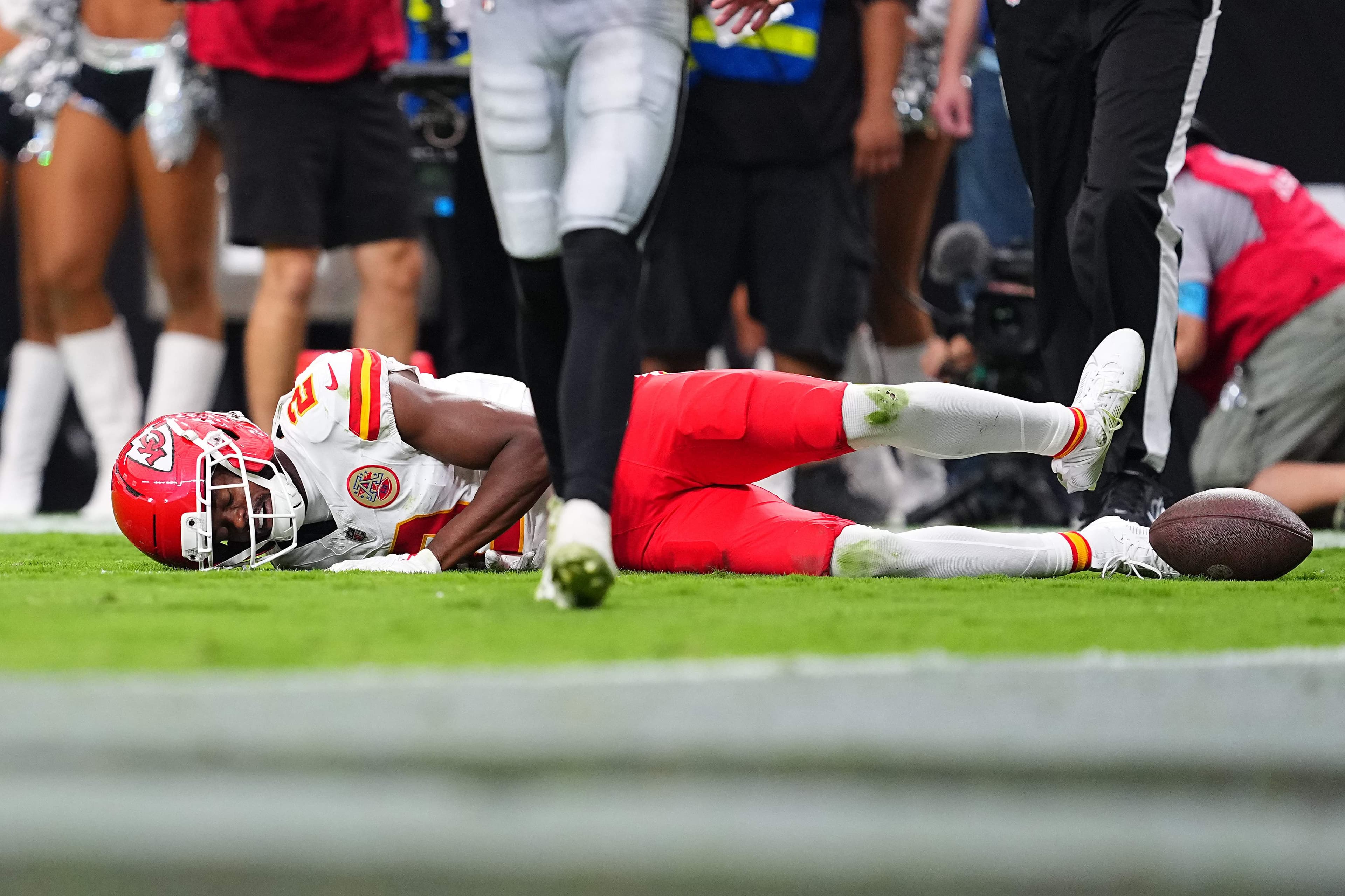
Kansas City Chiefs wide receiver Tyquan Thornton was taken off on a cart during the fourth quarter of the October 4, 2026, game against the Las Vegas Raiders at Allegiant Stadium in Las Vegas, Nevada. The game aired on CBS, and NFL Network later described Thornton's injury as a dislocated ankle that has left him out indefinitely.
The injury ended a 55-yard reception that had moved the ball to the Las Vegas 5-yard line. Raiders safety Treydan Stukes brought Thornton down on the play and landed on his ankle, and the television broadcast showed the receiver's left foot at an unnatural angle afterward, as Myles Simmons of Pro Football Talk described.
Ian Rapoport of NFL Network shared the injury update on October 4 in a post on X. According to Rapoport, doctors reduced the dislocation, and Thornton was able to make the team's flight home to Kansas City. He faces a full evaluation in the morning along with a second opinion, was described as out indefinitely but in good spirits, and the Chiefs have not revealed a potential return timeline.
The tackle went unpenalized, with the referees declining to flag the play during the game, and a debate has followed over whether Stukes used the hip-drop technique. The NFL can still review the tackle after the fact. If the league determines it was a hip drop, the safety could face further punishment, likely a fine, and that discipline would fall on the player rather than the Raiders, who will not be sanctioned because of the injury.
The fine schedule for hip-drop tackles calls for $17,911 for a first offense, with a second offense raising the penalty to $23,882. The NFL outlawed the technique in March 2024, ahead of that season.
Under the league's definition, a hip-drop tackle occurs when a defender, having wrapped up a ball carrier, rotates or swivels his hips and drops his weight onto the carrier's legs. Hunter Patterson of The Athletic detailed that definition in a 2024 story explaining how hip-drop tackles are defined and penalized.
The league said when it announced the ban that the technique causes lower-body injuries at 20 times the rate of other tackles. Stukes did not appear to have any intent to injure Thornton on the play, but intent is not part of how a hip drop is classified.
Some sports doctors have already weighed in on social media, labeling the tackle a hip drop. Simmons is among the observers who believe Thornton was injured on the banned technique, and he wrote on October 4 that the tackle appeared to be one.
Two matters remain open after the game: a recovery timeline for Thornton and a league decision on the tackle. The Chiefs have offered no return date beyond the indefinite outlook, and the NFL must now decide whether the tackle draws a fine.
Games to watch