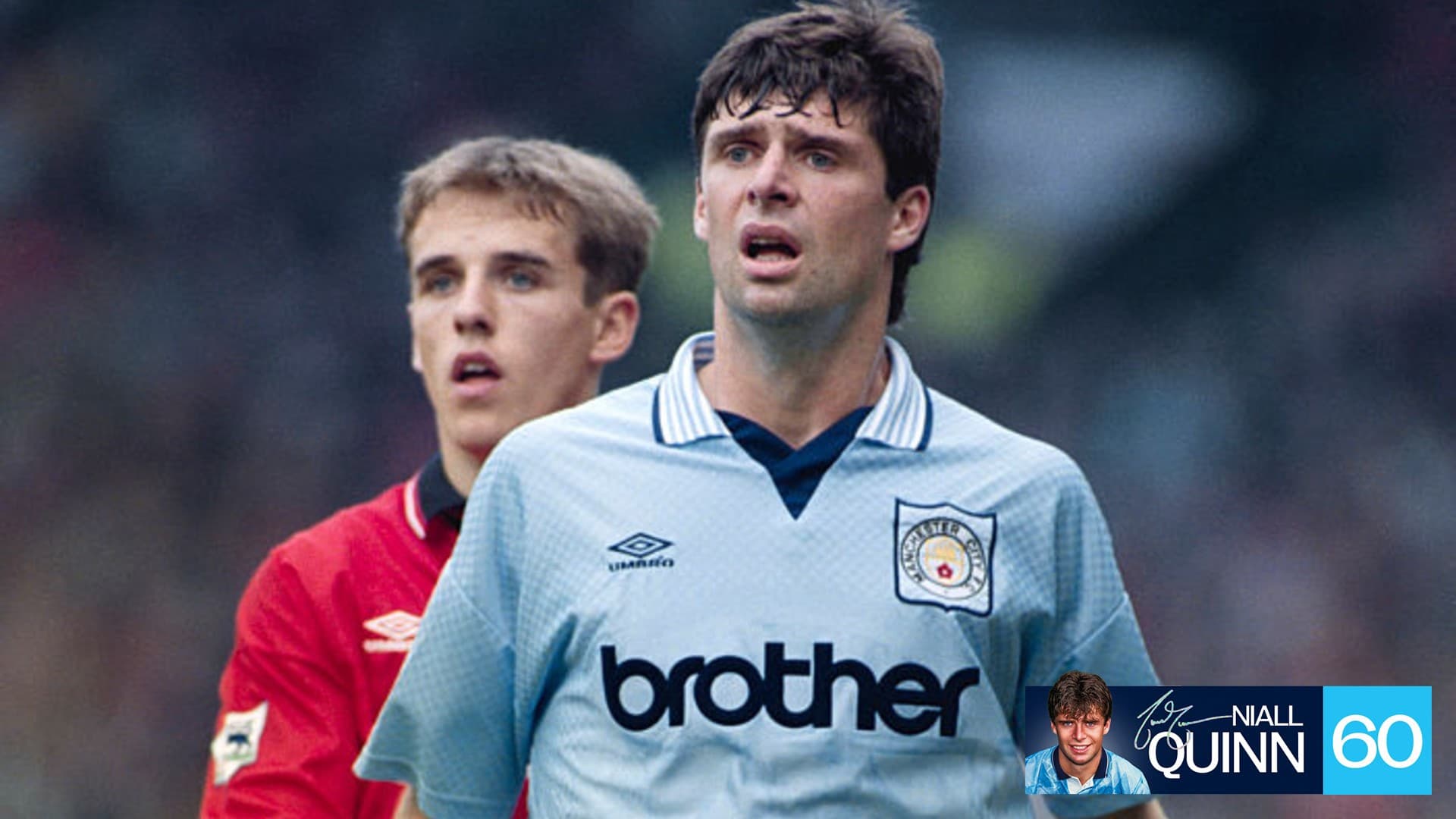
Brian Horton hails Niall Quinn as a manager's dream on his 60th birthday
The short version
- Niall Quinn is celebrating his 60th birthday; former Manchester City boss Brian Horton called him "an absolute dream to manage".
- Quinn scored 77 goals in 244 Manchester City appearances between 1990 and 1996.
- He joined City from Arsenal for £800,000 in 1989/90 and helped the club climb from the bottom three to a 14th-place finish.
- After leaving City he won promotion with Sunderland, served as the club's chairman and worked as a Sky pundit.
Former Manchester City manager Brian Horton has paid warm tribute to Niall Quinn, the striker he coached at Maine Road, as the Irishman celebrates his 60th birthday.
Former Manchester City manager Brian Horton has paid warm tribute to Niall Quinn as the former Republic of Ireland striker celebrates his 60th birthday. Horton, who led City between 1994 and 1996, described Quinn as "an absolute dream to manage" and said he could not speak highly enough of the man he coached at Maine Road.
Quinn scored 77 goals in 244 appearances for City between 1990 and 1996. Operating in an attacking lineup that also included Uwe Rosler, Paul Walsh and Peter Beagrie, the tall Irishman paired his goals with a dressing-room presence that Horton valued just as much.
When Horton took charge, Quinn was working his way back from a serious cruciate ligament injury, a setback the manager immediately recognized given how important the striker was. Horton said he soon discovered Quinn was not only a leading player and international, but an outstanding presence around his teammates who treated everyone exceptionally well.
Tactically, Horton admired Quinn's footballing intelligence, in particular his knack for dragging markers away to create time and space for himself. Strong in the air thanks to his height, Quinn also shielded the ball effectively and showed first-class movement and quality with the ball at his feet.
Horton's own arrival from Oxford United had been greeted with skepticism, including the "Brian Who?" headline that met his appointment. He credited senior figures such as Tony Coton, Keith Curle and Quinn with making the job straightforward, and counted Quinn as central to a group of genuine professionals.
Quinn grew up in Perrystown, Dublin, playing hurling and Gaelic football before committing to soccer, first as a goalkeeper and later as an outfield player. Arsenal signed him shortly after his 17th birthday under Don Howe, and he announced himself with a debut goal against Liverpool in December 1985. His breakthrough came in 1986/87, when he played 48 games in all competitions, 35 of them in the First Division, as Arsenal finished fourth, and he started the 1987 League Cup final, a 2-1 win over Liverpool in which Charlie Nicholas scored twice.
A £800,000 transfer brought Quinn to City late in the 1989/90 season, after 20 goals in 94 games for Arsenal, though he missed the deadline to make his debut at Luton by 10 minutes. He started the next match at home to Chelsea and headed an equalizer after Gordon Durie had put Bobby Campbell's side ahead. Howard Kendall, who had replaced Mel Machin with City in the bottom three, steered a run of one defeat in the final nine games that lifted the club to 14th before he returned to Everton in November 1990.
Player-coach Peter Reid then guided City to consecutive fifth-place finishes, with Quinn contributing 22 goals in the 1990/91 season. That campaign followed Italia 90, where Quinn spearheaded Ireland's attack under Jack Charlton, scored a late goal in a draw with a Netherlands side containing Marco van Basten, Ruud Gullit, Frank Rijkaard and Ronald Koeman, and helped Ireland into the quarter-finals of a tournament he later called "the making of me".
Upon leaving City, Quinn linked up with Reid at Sunderland, winning promotion as a player before a short stint as caretaker manager and a successful run as the club's chairman. He also built a reputation as a television pundit with Sky and supported several charitable causes, including fundraising that helped deliver a children's centre at City Hospitals Sunderland. Horton said those later achievements came as no surprise, calling Quinn a very bright man who would have thrived at anything and the sort of player every manager wants.
Games to watch